
Running a business in today’s competitive world requires funds at various stages—startup, expansion, working capital, machinery purchase, stock procurement, or handling cash-flow gaps. With so many financing options available, two of the most commonly compared choices are business loans and overdraft facilities. But how do you decide which one is right for your business?
In this detailed guide, we will deeply analyze the concept of business loan vs overdraft, understand how each works, their benefits, limitations, interest structures, eligibility, and the ideal scenarios where one might be better than the other. By the end, you will have a clear understanding of which financing option suits your company’s financial needs.
What Is a Business Loan?
A business loan is a formal credit facility offered by banks, NBFCs, and financial institutions to help business owners meet large financial requirements. It can be secured (backed by collateral) or unsecured (no collateral). The loan comes with a fixed tenure, structured EMI, and a predetermined interest rate.
Key Features of Business Loans
- Fixed loan amount
- Fixed repayment schedule
- EMIs with interest + principal
- Higher loan eligibility
- Long repayment tenure (1–15 years depending on loan type)
- Suitable for growth and expansion
Business loans are ideal for companies that require large funds and prefer structured repayment instead of dynamic withdrawals.
What Is an Overdraft?
An overdraft (OD) is a credit facility linked to your current account. Banks allow you to withdraw more than your account balance up to a pre-approved limit. You pay interest only on the amount you utilize, not on the entire limit.
Key Features of Overdraft Facility
- Flexible withdrawals and deposits
- Interest charged only on the used amount
- No fixed EMI
- Limit is reviewed annually
- Best for short-term working capital needs
- Requires security or collateral (property, fixed deposits, etc.)
The overdraft facility is ideal for businesses that experience daily cash-flow fluctuations.
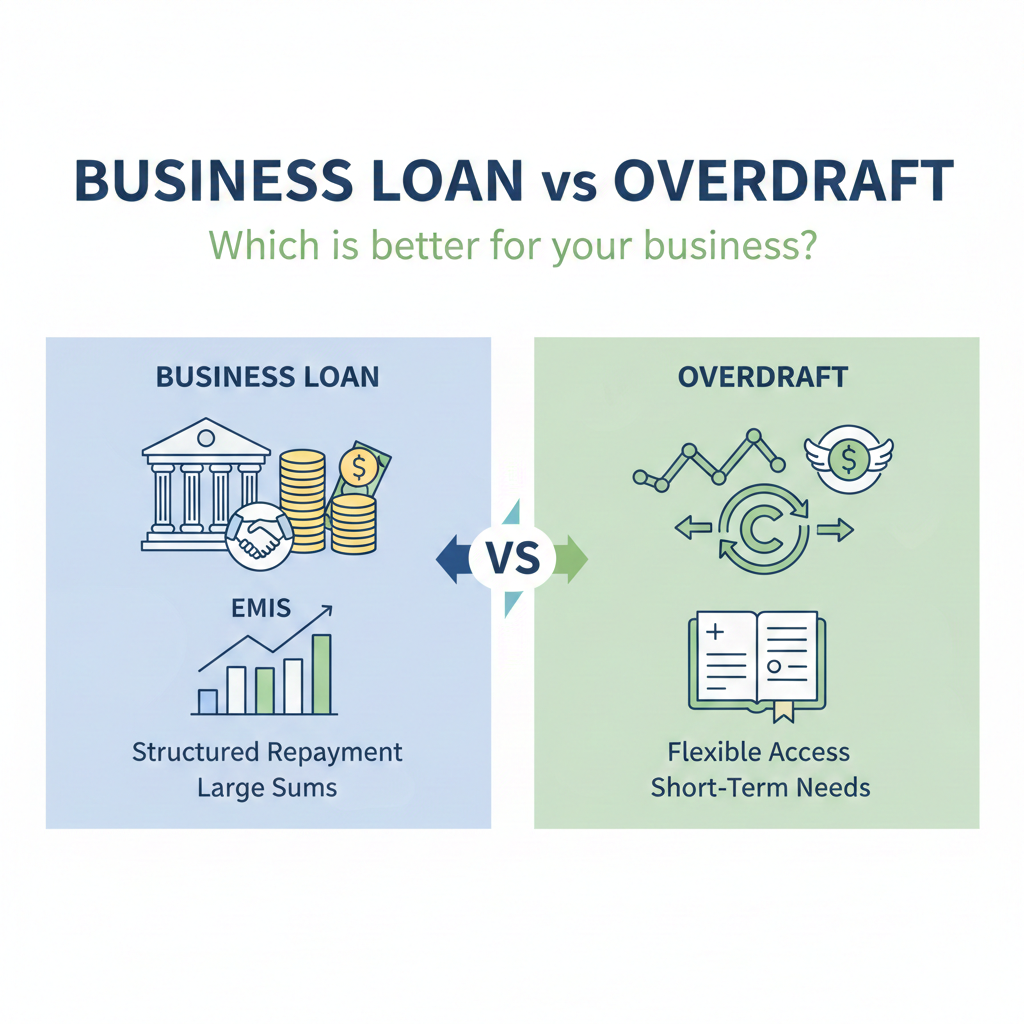
Understanding the Difference: Business Loan vs Overdraft
When evaluating business loan vs overdraft, it is important to understand how each product functions differently. Business loans are long-term financial instruments, whereas overdrafts are short-term solutions designed for operational needs.
Business loans help in:
- Purchasing equipment
- Business expansion
- Buying property
- Setting up a new unit
- Hiring manpower
Overdrafts help in:
- Daily cash management
- Paying suppliers
- Managing payroll
- Handling delayed receivables
- Short-term liquidity
Both serve different purposes, and choosing the right option depends on your business goal.
Interest Rate Comparison
Understanding the interest rate structure is crucial when analyzing business loan vs overdraft.
Business Loan Interest Rate
- Generally fixed or floating
- EMI includes both principal + interest
- Interest charged on full loan amount
Overdraft Interest Rate
- Charged only on the utilized amount
- Interest rate slightly higher than business loans
- No fixed EMI
For example, if your OD limit is ₹10 lakh but you only use ₹2 lakh, you pay interest only on ₹2 lakh.
If your requirement is unpredictable, overdraft may be beneficial. But if the requirement is long-term and structured, a business loan is usually cheaper.
Repayment Structure
A major factor in deciding business loan vs overdraft is how repayment works.
Business Loan Repayment
- Fixed monthly EMIs
- Predictable repayment schedule
- Ideal for stable cash flow
Overdraft Repayment
- No EMI
- Repay anytime by depositing into your current account
- Flexible but requires discipline
If your business generates steady income, EMI-based repayment is suitable. If your income fluctuates frequently, overdraft offers more flexibility.
Eligibility Requirements
When comparing business loan vs overdraft, eligibility criteria differ significantly.
Business Loan Eligibility
- Minimum business vintage: 1–3 years
- Bank statements for the last 6–12 months
- GST filings, ITR, financials
- Good credit score (usually 650+)
Overdraft Eligibility
- Strong banking relationship
- Current account with regular transactions
- Collateral often required
- Good financial history
OD is easier for businesses with long-term accounts and collateral, but unsecured overdrafts are available only to top-tier customers.
Loan Amount and Limit
Another important difference in business loan vs overdraft is the amount you can borrow.
Business Loan Amount
- Can be high: ₹5 lakh to ₹50 crore
- Depends on business type, income, documents, and bank policies
Overdraft Limit
- Usually lower than business loans
- Often ranges between ₹1 lakh to ₹5 crore
- Limit depends heavily on collateral and bank relationship
Therefore, if you need a large investment, business loans are the better option.
Which Option Is Best for Working Capital?
When discussing business loan vs overdraft, businesses often look for the best option to manage working capital.
Overdraft is best for:
- Managing day-to-day expenses
- Handling customer payment delays
- Paying vendors on time
- Sudden cash needs
Business loan is best for:
- Long-term working capital
- Bigger purchases
- Sustained growth
If your requirement is recurring and uncertain, OD is ideal. For confirmed and planned expenses, business loans are better.
Which Option Is Better for Business Expansion?
When it comes to expansion, the business loan vs overdraft choice becomes clearer. Business expansion requires:
- Large investment
- Long-term capital
- Structured repayment
Overdraft is not suitable because:
- Limit is renewed annually
- Higher interest
- Smaller limit
Therefore, business loans are the clear winner for expansion projects.
Flexibility Comparison
One of the biggest considerations in business loan vs overdraft is flexibility.
Business Loan Flexibility
- Low flexibility
- Fixed EMIs
- Tenure locked
Overdraft Flexibility
- High flexibility
- Withdraw anytime
- Repay anytime
If flexibility is your top priority, overdraft is the better choice.
Cost Comparison (Illustration)
Let’s understand the business loan vs overdraft comparison through an illustration.
Business Loan Example
- Loan: ₹10 lakh
- Interest rate: 14%
- Tenure: 36 months
- Monthly EMI approx: ₹34,186
- Total interest paid ≈ ₹2.3 lakh
Overdraft Example
- OD limit: ₹10 lakh
- Interest rate: 16%
- Usage: Only ₹3 lakh
- Duration: 6 months
- Interest paid ≈ ₹24,000 (approx)
Overdraft is cheaper only when usage is low. If you continuously use the full OD limit, it becomes more expensive than a business loan.
Security & Documentation Differences
Understanding the documentation requirements helps in evaluating business loan vs overdraft.
Business Loan
- Can be unsecured
- More documentation
- Longer approval time
Overdraft
- Mostly requires collateral
- Designed for existing customers
- Faster approval (especially if backed by FD or property)
If you want unsecured finance, the business loan is better.
When Should You Choose a Business Loan?
You should choose a business loan in the following situations:
- Need a large amount of capital
- Want predictable monthly EMIs
- Planning business expansion
- Buying machinery or property
- Long-term working capital needs
- Want to avoid pledging collateral
In business loan vs overdraft, the business loan wins for long-term and large-scale financial requirements.
When Should You Choose an Overdraft?
Choose an overdraft facility if:
- You have frequent cash flow fluctuations
- Need funds only for a short period
- Want to pay interest only on usage
- Have collateral like property or FD
- Need flexibility without EMI burden
OD is the best short-term working capital solution.
Final Verdict: Is a Business Loan Better Than an Overdraft?
When analyzing business loan vs overdraft, there is no single answer because both serve different financial needs.
Choose a Business Loan If:
- You need high funding
- This is for long-term use
- You want structured repayment
- You need unsecured financing
Choose an Overdraft If:
- You want flexibility
- Your cash flow fluctuates
- You want to pay interest only on usage
- You have collateral
In summary, neither is universally better; the best option depends entirely on your business goals. However, for growth, expansion, and strategic investment, business loans are the superior choice. For short-term liquidity and daily operations, overdraft facilities provide unmatched flexibility.
Conclusion
The debate of business loan vs overdraft revolves around purpose, tenure, flexibility, and cost. To make the right decision, analyze your business revenue, cash flow pattern, loan requirement, repayment ability, and urgency. Many businesses even use both options—OD for routine cash gaps and business loans for major investments.